Friday, March 13, 2026
An Ode to Gata Linda
Wednesday, October 16, 2024
Miami Beach Honors Desi Arnaz of "I Love Lucy"
Growing up in Miami Beach, I was very familiar with St. Patrick Catholic School. Although I attended a public school (North Beach Elementary a few blocks away,) my upstairs neighbors Katheline and Jennifer Cortes, attended the St. Patrick's and I attended their events at the school. I also took CCD classes there for my communion and confirmation.
So I was surprised to learn that Desi Arnaz, best known as the hunky Cuban-American bandleader and for playing the devoted husband Ricky Ricardo on the beloved "I Love Lucy" sitcom, graduated from St. Patrick's. Not just that, he learned English there, became a musician and had his early brush with fame when he started to perform the conga at the Park Avenue restaurant and nightclub before making it big on Broadway and Hollywood.
| via The New York Times / Library of Congress |
This week, the city of Miami Beach honored the entertainer's early years in Miami and Miami Beach after he left Cuba as a teenager. I wrote a story for paper, The New York Times, about Mr. Arnaz's journey from Cuba to Miami and Hollywood. The marker sits outside the Miami City Ball, near where the Park Avenue nightclub stood by Collins Avenue.
Wednesday, September 23, 2020
More from the Heart
My editors at the New York Times asked me recently to share my open heart surgery and what that experience was like in the middle of a pandemic. This is a different version from my previous blog post on how I discovered the aortic aneurysm and how I went about getting it repaired.
In the new piece, I dive into the decision making process of holding off on surgery (for months) because of the coronavirus crisis. Other patients are doing the same, delaying important procedures. I also highlight the various coronavirus protocols I observed during my five-day hospital stay at Mount Sinai Medical Center in Miami Beach where I had the surgery.Below is the print version of the piece which was published Sept. 23 in the A section. In case you are wondering, I am doing well. I still have some chest soreness which is expected and should last a few more weeks. The scar on my chest is healing well. I've already become used to it. Once the soreness is gone, I will able to run (and sleep on my side again.)
Wednesday, September 2, 2020
From the Heart
It's weird to think that my heart has a new part or an artificial section (featured in light blue in the above illustration along with my messy notes.) I discovered the aneurysm by accident. Before a colonoscopy in Boston, my heart wouldn't stop racing. It was as if I was running even though I was lying down waiting for the happy drugs. The gastroenterologist halted the procedure and strongly suggested I see a cardiologist which I did a few months later in Miami.
That led to an appointment with cardiologist Dr. Todd Heimowitz followed by a series of follow ups and tests (EKG, echocardiogram, CT scans) that eventually revealed the aneurysm or "slightly enlarged aortic root." It was being monitored and managed with blood pressure medicine (and I was okay with that.) Before I moved to New York last fall, Dr. Heimowitz had strongly suggested that at some point whenever I visited Miami again, that I seek a second opinion from Mt. Sina's chief cardiologist Dr. Steve Xydas who specializes in aortic repairs and aneurysms. Aortic aneurysms affect about 15,000 Americans each year and they are most common in men and people over the age of 60, according to Columbia Surgery.
After meeting him in January of this year, he strongly suggested I have the surgery done and not to put it off. The news struck a huge fear in me. Open heart surgery? I thought I was too young for that. I wasn't 60 as the statistics show and I am not a smoker. More importantly, I didn't want my chest carved open like a Thanksgiving dinner.
I had thought I could just live with this for the rest of my life (knowing in the back of my mind that I had a grenade in my heart) but that would not be the case. While I was in Miami, Dr. Xydas quickly ordered another CT scan which showed that the aneurysm had grown to 5 cm (or a total of two-inches.) I was right at the line, near the danger zone of bursting. He said it's better to do this as a choice than during an emergency. He and his staff were also confident that I would be a strong candidate for the surgery and come through well given my "young" age and my overall good health.
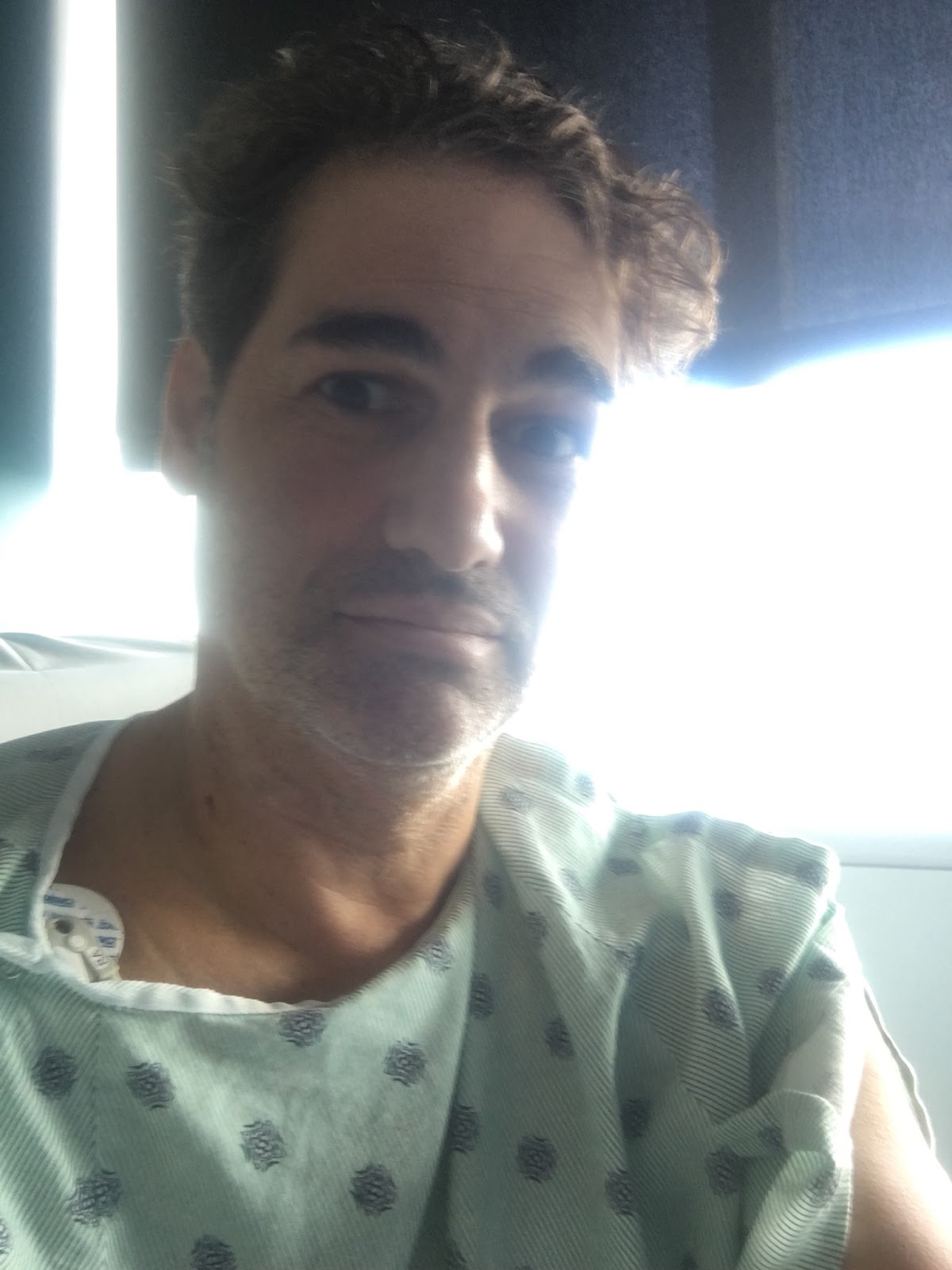
I had the surgery in mid-August (I had no idea that the nurses would shave EVERY THING even though I keep explaining that my heart was in my chest and not below my waist but that's another story.) The photo below is the second day after my surgery when I got my own private room after being in the ICU. If I look a little out of it, it was from the painkillers. After five days at the hospital (no visitors were allowed) and now several days recovering at home, so far so good, although my chest is really sore (they had to cut through my breastbone to reach the heart.)
My chest feels like someone took a hammer and struck me in the middle of my torso. It hurts when I laugh and when I cough (I have to hold a pillow to my chest for the latter.) I am somewhat limited in my movements; I am doing my best and feeling a little like old myself every day.
I am walking a few blocks a day. No running (which I miss,) no driving and no lifting weights...for now. And I definitely can't play Twister, not that I would. I went back to work a few days ago, eager to write news articles once again. In the meantime, I am thankful this is behind me. I'm also kinda getting used to my badass battle heart scar which you can see below. Maybe I can turn it into an awesome tattoo at some point.
Sunday, August 2, 2020
When I Was the Jumpingest Boy on My Block
I jumped so well that I won a few trophies and ribbons from the Miami Beach Parks and Recreation Department when I was in the after-school and summer camp program at Muss Park. That caught the attention of The Miami Herald which featured me in a small profile about my jumping rope skills.
I was 10 at the time and I remember the reporter Laura Misch visited our apartment. She sat with me in our living room and gently asked questions about what I loved about the sport and my future in it. She was respectful, sweet and really really pretty. She probably wanted to write about something more serious and bigger than a story about an effeminate boy with dark brown hair who was happy with a rope in his hand. But she made me feel like I was important that day and her sole focus. She genuinely seemed interested in knowing me.
After I happily showed her my collection of trophies, I then showed her what I could do. We stepped outside my two-story apartment building. A Herald photographer Michel du Cille later met up with me and I showed him what I could do too. With my white rope in hand, I jumped fast, hard, the rope and my arms a blur in motion. I remember I jumped so much that afternoon that my calves ached into tight balls of pain. (Below is the photo that used with the story.)
A couple of days later on May 22 in the Sunday Miami Herald Beach Neighbors edition, there I was on page 14 under a section called "Portrait of Beaches People." My parents were so proud and especially my Tio Frank (Uncle Frank,) my mom's brother who was a boxing coach in Cuba and Venezuela where his boxers trained by jump roping. I remember he bought a stack of the Herald and told people about his jump roping nephew.
After the story was published, my classmates' moms and my teachers congratulated me when they saw me at North Beach Elementary or at Muss Park. (Back then, The Miami Herald was everywhere, dotting practically every household lawn and filling newsstands on every business corner, and I felt like everyone from Miami Beach to Bay Harbor Islands, the coverage area of Beach Neighbors, saw the piece.)
Below is the text of the story that the Herald published about me. I never got to see Ms. Misch again but I never forgot her professionalism and how she captured the spirit of a 10-year-old boy through her short 333-word story or what we call a "brite" in journalism.
Coincidentally about four years later, I joined the school newspaper at Miami Beach High. Less than two years later, I began working as an intern in the same Neighbors office she worked out of. I began writing about Miami Beach's unsung heroes and colorful personalities like she did. I wanted to make the people I wrote about feel the same way Ms. Misch made me feel about me, that they mattered and their story was important, something I continue to do today at The New York Times.
BY LAURA MISCH Herald Staff Writer
Tell him there's no future in jumping rope and 10-year-old Johnny Diaz just smiles and bounces on. And on. And on.
He's the jumpingest boy on his block, in his school, maybe the world. Johnny Diaz is a rope jumping fanatic. While other kids his age catch fly balls and go for touchdowns, Johnny likes the simplicity of a piece of rope, a place to jump and his own boundless energy.
He practices three hours a day, sometimes, jumping fast and slow, forward and backward, arms crossed and arms rigid. Before he saved up and bought his own rope, Johnny practiced his routines with an electrical cord.
He's already worried about being a has-been in a little kids' game. In fourth grade at North Beach Elementary, he's a year too old to win any more trophies. He's also getting heavier, and that spells the end for any serious rope jumper. He was clocked once at 200 jumps a minute. Now the best he can do is 155. You've got to be light on your feet.
But Johnny has memories. The trophies and ribbons, more than 20 of them, sit on his parents' dresser. He won his first trophy at Muss Park, in first grade. It was the beginning of an unflagging enthusiasm for the gentle art of jumping rope.
The kids tease him.
"People say it's for girls, but it's not." Jump. Jump. Jump.
"Some people call me a sissy." Jump. Jump. Jump.
"But I don't care because I want to be a champion jumproper." Jump. Jump. Jump.
He knows he won't make it. He realizes, in the twilight of his rope jumping career, that there are other possibilities in the world.
"Tennis," he said, "is what I plan to play." He also collects coins and stamps.
There was one kid at school who told Johnny in so many words that anybody who spent his time jumping rope was a fool.
"If he said that in front of a boxer, he'd punch him." Jump. Jump. Jump.
Thursday, June 4, 2020
A Review of "Year of the Cock"
I wasn't sure what I was getting into when I began reading "Year of the Cock" by Alan Wieder.
For one, a rooster stares side-eyed from the book's cover. Was this about a bird?
I also went to elementary, middle and high school in Miami Beach with the author where we shared several classes including French, English and Journalism. We worked together well when he was my editor at our high school newspaper "The Beachcomber" our junior and senior years. Alan was a serious, whip-smart intellectual, a great writer and tennis player whose laugh I would hear from across our newsroom. I knew he eventually went to Columbia University in New York and then I lost track of him except for an occasional Facebook message about 12 years ago.
Years later when I learned about his 2009 memoir (which he noted is 87 percent true,) I was curious to find out what happened in his life after Miami Beach. I was not disappointed as I read the book in the Year of the Rat.
The "Year of the Cock" follows Alan's tumultuous mid-life crisis at the age of 30 in Los Angeles where he worked as a successful reality TV producer of hits such as "My Big Fat Obnoxious Fiance,'' "Joe Millionaire" and "Temptation Island."
It's 2005, the Year of the Rooster, and Alan was married to a lovely interior designer named Samantha whom he met in college. They had been in a committed relationship for 10 years including more than two years married. The book follows his decision to leave her so he can live the ultimate life of a lothario, boozing, partying and hooking up with younger women in L.A.
He lived in a fellow producer's fancy estate and then his own bachelor pad. For his new life, Alan bought a classic Porsche 951 and embarked on his debauchery while listening to gangster rap.
The decision to leave his wife was complicated, a mix of external family issues, an imbalance with the work-to-home-life ratio (Alan was working 14 to 18 hour days on his shows,) boredom and resentments that built up over time. The story is told through Alan's point-of-view so the reader doesn't really get to hear much of Samantha's voice.
Three months into his new bachelor life, Alan stood naked and looked at himself in the bathroom mirror and he became obsessed with his penis.
"I tried every means of halting the nagging thought in my head: My penis is too small, too small, too small, too small," Alan described in one chapter.
"My penis looks smaller than it did yesterday, and even smaller than it did the day before that," he continued.
"My mind fulminated worse than ever with catastrophic thoughts about my penis, myself and my life such as it had become," Alan wrote in chapter 7.2.
To help him deal with these unwanted penile thoughts, Alan began researching the average penis size using charts and measurement tactics including a Ninja Turtles six-inch ruler and tape measure. He also looked up celebrity penises for comparisons and watched pornos to gauge various sizes.
He then started experimenting with methods of PE (penis enlargement) which included weeks of rubbing, pulling, tugging, twisting, stretching, ouch! One method seemed to help grow it a bit. (For inquiring minds, he said he falls in the "above average territory" in chapter 6.0)
When the penis fixation became all too much, Alan turned to a psychotherapist who gave him the tools to deal with the penis craziness, the "issue of inadequate self-identity" and the factors that led to the marital troubles with his wife (and then trying to make things right.)
In a funny way, the book serves as the ultimate thesaurus for the word penis. I never knew there could be so many words for it but Alan found or came up with them. They include schlong, pong, pecker, dong, snorkel, pisser, rod, blood bomber, wang, sword, and of course, cock (and the list went on and one and so did the pages about his penis paranoia.)
The book is an honest, entertaining look at how Alan got his groove back and how he began to work on himself mentally and emotionally, with help from the therapist and his childhood best friend, producing partner and actor Steve Sobel (another classmate of mine from elementary, middle and high school.)
![]() |
| Steve Sobel and Alan Wieder |
While it was hard to read about Alan drinking, hungover, partying and ignoring his wife's calls for months, I appreciated his love for his amigo, his consorte, his compadre. Both grew up as Jewish kids in Miami Beach. And reading about those flashbacks about their many firsts and North Beach Elementary oily pizza square lunches brought back some of my own happy childhood memories.
The scenes with Steve are funny and sweet and they lighten and carry the book: Two pals who know each other inside and out and support one another, no matter what. As Alan leaned on Steve in figuring out his new bachelor life and his penis-obsession, Alan too supported Steve as he wrestled with his jitters about getting married to his longtime girlfriend Marita.
Steve generously gave Alan some of his old furniture for his new bachelor pad and gladly helped him move using his Ford pickup. Alan organized a fun and simple bachelor party in a cabin in the woods and nailed his toast at his wedding. There is a real love there and their scenes could have easily been part of a reality TV show all together or the basis of an Adam Sandler movie.
Maybe the book should have been called "Year of the Friend" because that's what I took away from it, that no matter what happens in life, having a good friend by your side can make all the difference, especially during an early mid-life crisis or while creating a reality show.
P.S. Alan has another book, a collection of sketches of girls he has dated. It's called "Exes."
Thursday, March 21, 2019
Looking back at 'Queer Miami'
Boy, was I wrong.
The exhibit was so much more comprehensive than I had anticipated. It looks back at more than 100 years of LGBTQ history in Miami and Miami Beach from the early Florida ordinances that criminalized homosexual and transgender behavior to the impact of gay/lesbian immigration in the Magic City.
I had heard so much buzz about the annual gala that I wanted to experience it. When I walked into the historic home and explored the manicured maze of lush gardens, I was struck by how everything from the guests' fashion to the elegant table decorations and chairs was awash in white. Everyone was in a celebratory mood, sipping wine and drinking to a good cause.
I was only at the exhibit for an hour (I got there at 4 p.m. and they were closing at 5 p.m. so I was rushing somewhat.) But I plan to return to soak up more of the history.
Thursday, May 3, 2018
Honoring my old Honda

After watching 'The Fast and Furious' stars talk about their first cars this morning on NBC's 'Today' show, I instantly thought of my first set of wheels. I also spotted a clone of the car and its sedan version in the new Childish Gambino video at the 3:28 mark.
Here is a trip back to my old Honda (and curly bushy '90s hair.) In honor of the car's sky-blue hue, the text has a blue background.
It was my worst-best car. The second generation 1982 Honda Accord hatchback was my first car, a belated 17th-birthday gift from my parents in Miami Beach. The first time I saw it, the car was parked, with all its glorious small dents, in the driveway of our home. No one was around when my friend Kellyn and I discovered the car but as soon as we peeked through the window, I knew this was my car. It spoke to me. Sky-blue with a whoosh Accord logo written in italics on each side.
The smallish hatchback looked sporty, cool, contemporary despite being 8 years old. Something about the word "Accord" sounded important, unique. I couldn't wait to drive it. I just had to figure how to drive it. The car was a stick-shift. But after a few starts and stops and starts and stops, I nailed down how to switch gears without that annoying grinding noise and I hit the roads of Miami Beach.
With its 75-horsepower engine, the car provided me a smooth ride with enough pep to speed down Pine Tree Drive or whip and weave on Interstate 95.
A navy-blue velour material sheathed the seats that seemed to suck you in. The shag carpeting tickled my feet. The AC was icy cold blowing my curls of dark brown hair. Whenever I pulled away from a greenlight, the car carried an electronic hum, reminding me of a futuristic exhaust of a spaceship.
When it rained, it literally poured inside the car. Sealant problems plagued my front-glass windshield. I used napkins to dab the wet spots that pooled on my dashboard but my uncle/godfather patched that up for me. Another time, when my high school lunch-bunch friends piled into the car, a rattling sound followed us as we left the school lot.
The car dragged the muffler like the end of a Just-Married chain of cans. We didn't make it to Burger King that afternoon and my dad gladly took care of the repair. Although I lived and hung out in Miami Beach, I had trouble leaving the 33140 area code. The car's temperature spindle would inch into the red zone if I ventured over the causeway to the Miami side or if I idled in traffic too long. I replaced the clunky radiator.
When the car did work properly, it sparkled and I beamed just as brightly whenever I pulled into my driveway, my high school parking lot or at The Miami Herald building where I was an intern penning a weekly column titled "Friends and Neighbors." The Accord meant independence and I felt that spirit whenever I started the engine or paid for my own gas at the local Amoco station.
This was my Accord and I could deal with all the minor auto warts I had inherited from the previous owners. The car liberated me. I felt like I was growing up, becoming a man. Too bad the Accord didn't last through high school. The car only survived two months in my hands.
After making a McDonald's run with Kellyn on Thursday afternoon, I collided with a rental car driver and my Accord spun down NE 30th Street off Biscayne Boulevard like a dreidel. (No one was hurt but we still can't account for the missing medium chocolate shake that I had in my hands.)

Post-crash, the car sat lifeless, its rear folded in crushed like an accordion. I felt the same way. A tow truck dragged the car back home where an insurance adjuster eventually declared it a total loss. Until it was towed away to a car cemetery, I sat in the car each day, my fingers grazing my weathered steering wheel as I relished my short-lived adventures this vehicle gave me. Then it was gone.
Over the years, I've seen clones of that light-blue Accord. When I lived in Cambridge, Massachusetts, I often saw an identical car (but with lots and lots of rust) parked on side streets in Harvard Square. I was often tempted to leave a note for the owner to say "I used to own a car just like this high school. I am glad to see that it's still running for you." Not that long ago, I spotted another copy zoom by me in Miami's Little Havana. Whenever I see my Accord's double, it's as if a ghost from my past, my teen years, another time, dashes by.
But I like to think that my old car may have been restored by someone and that it's out there somewhere in South Florida giving another owner the pleasure it gave me for those two sweet months.
And what a surprise, an identical version of the car can be spotted in the Childish Gambino video toward the end. (Screen grab below of the two blue early 1980s Honda Accords. The one on the lower right looks just like my old car.)
Yep, that's me (below) with my 1982 Honda Accord parked outside a friend's apartment building in South Beach. Check out the dents (and my hair).

And yep, that's me below posing for a cheezy photo with my current car, a Volkswagen Golf. (I stuck with the blue hatchback theme.)

(The top two Honda images above were original magazine ads and brochures for the 1982 Honda Accord model.)


.jpg)